A monitor for anything plugged into your Mac.

Plug in a camera or a capture card and look at it. You pick the resolution and frame rate, the audio comes out of your speakers, and you can record.

Coming to the Mac App Store What it does

macOS 26 or later Native Swift Network access none Category Utilities

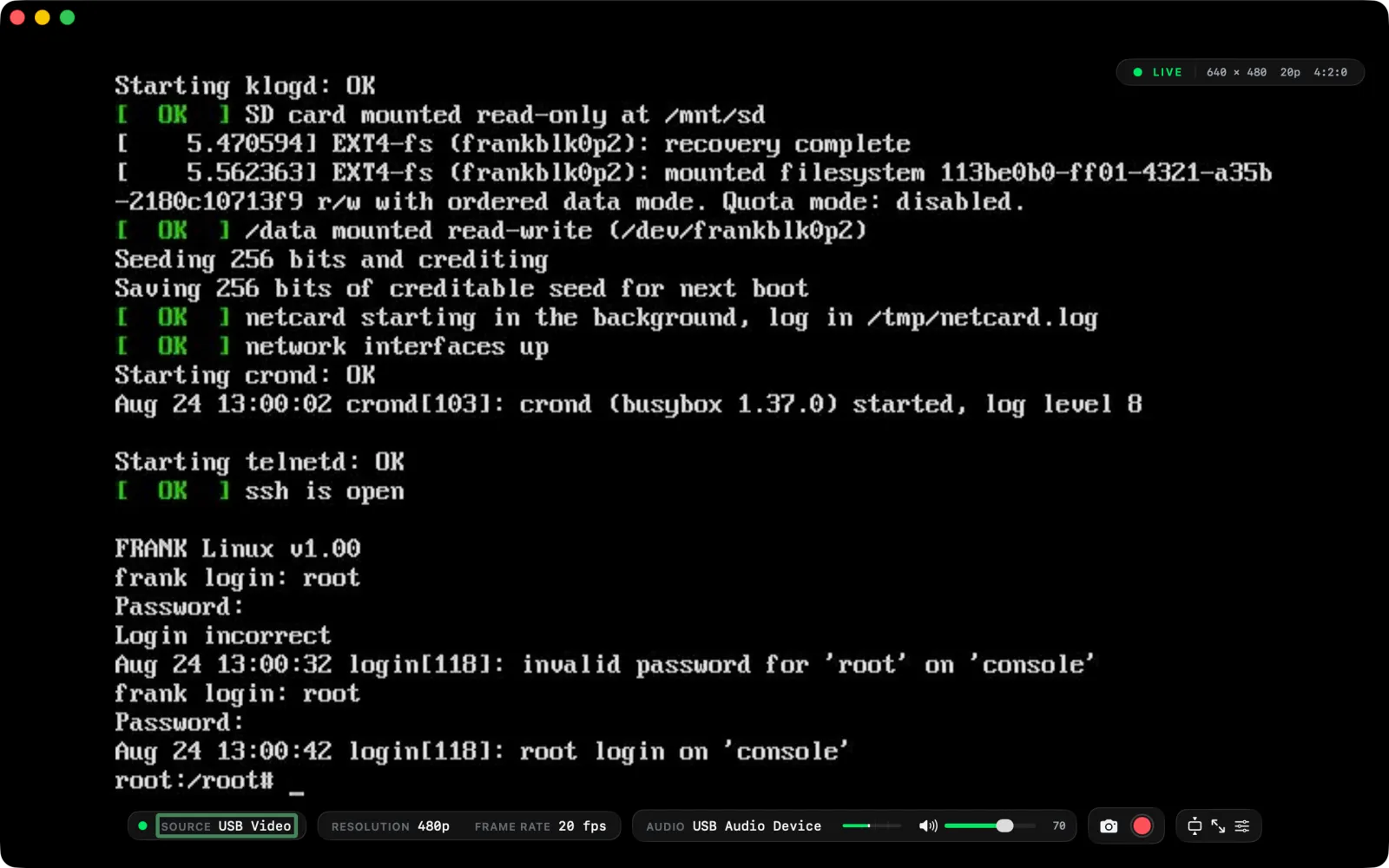
The VideoMonk window showing a live capture-card picture. A status capsule in the corner reads LIVE, 640 by 480, 20p, 4:2:0, and the control bar along the bottom shows the source, resolution, frame rate, audio input and volume.
Live 640 × 480 · 20 fps · 4:2:0 — the readout is the device's own, not a guess.

Why it exists

macOS has no way to just look at a video source.

QuickTime's New Movie Recording is a recording window that happens to show a preview, and it hides the format controls completely. Everything else that will show you a capture card is a streaming suite, an editor, or a conferencing app that wants your camera for something else.

VideoMonk is the viewer instead. Choose a source, set its resolution and frame rate, choose an audio input, set the level, and watch. It works with anything macOS recognises as a camera: the built-in FaceTime camera, USB and UVC capture cards, HDMI-to-USB adapters, Continuity Camera, and Desk View.

No accounts, no ads, no in-app purchases, and no network access. Stills and recordings are written to your own folders and stay there.
What it does

Format control first, because that is the part everything else hides.

Format

Every resolution and frame rate the device actually reports

Not a menu of what a camera ought to support — the list the hardware hands over. Devices that expose the same resolution under several codecs show all of them, because they are not the same thing. Pick one and it is locked in, with the active combination spelled out underneath.

Audio

Any input, on your speakers

Route the audio that arrives with the picture — or any other input — to the system output. Volume slider, mute, and a stereo level meter with peak hold.

Capture

Stills and recording

Save a frame as lossless PNG or JPEG, or record video and the selected audio input into a single .mov. Monitoring keeps running while you record, and the source and format are locked for the take.

Window

Sized to the source

The window can size itself so the picture renders at source resolution: a 640 × 480 source opens a 640 × 480 window. Anything too big for the screen steps down by half.

Hot-plug

Survives unplugging

Pull the cable and the list updates. Plug the same device back in and the picture returns on its own — no relaunch, no reselecting.

Framing

Fit, fill, full screen, and a border

Fit the picture into the window or fill it, go full screen, and set a black border between the picture and the window edge as wide as you want it.

Chrome

Controls that get out of the way

The bar fades three seconds after the pointer stops and returns when you move it; clicking the picture toggles it. Resolution and frame rate are remembered per device, along with the audio input, volume, and view mode.

In use

Capturing a Linux console

The source in these shots is a capture card fed by a machine running Linux — which is, in practice, exactly the sort of thing you point this at.

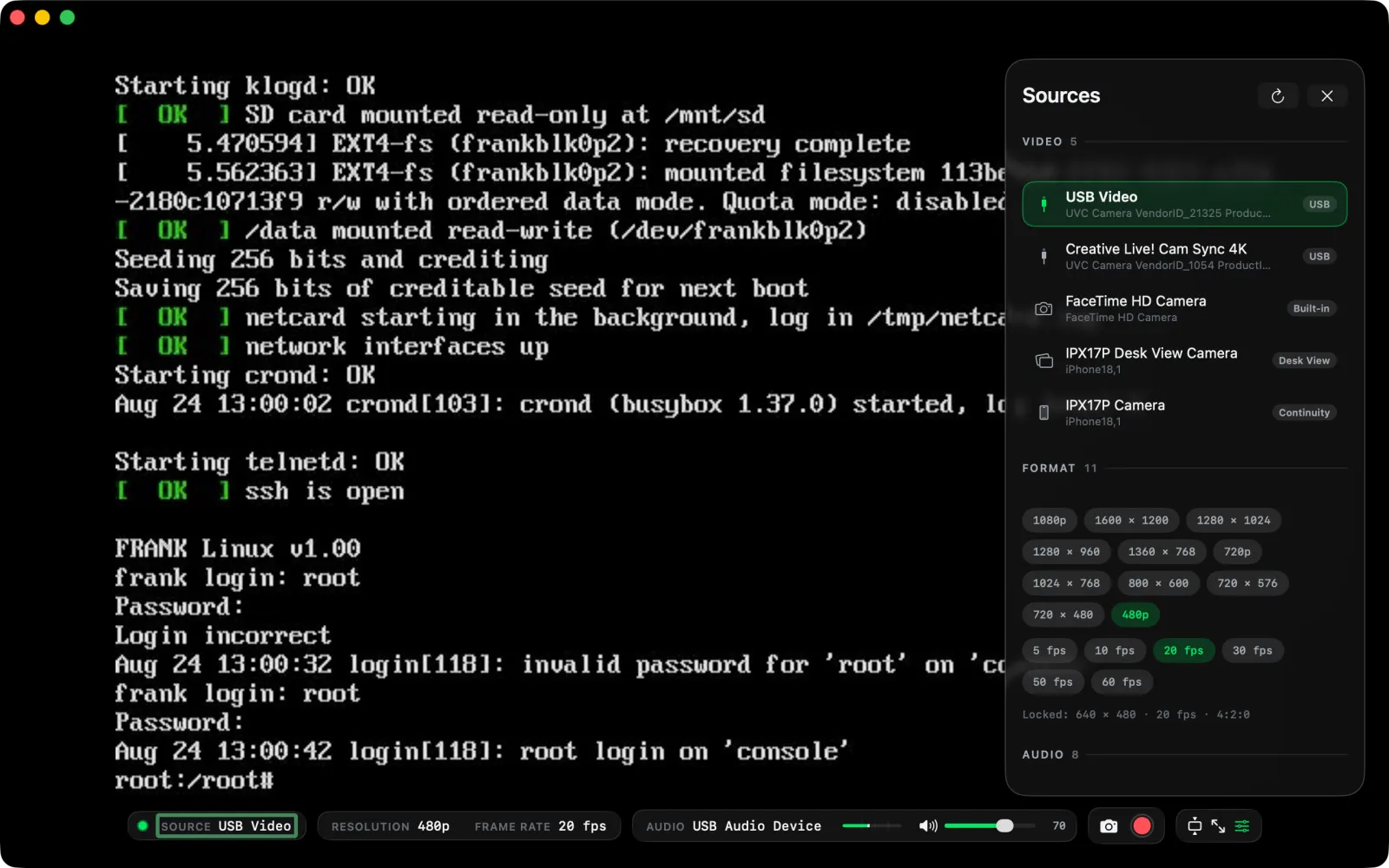
The Sources panel open beside the picture, listing a USB Video device, a USB webcam, the FaceTime HD Camera, a Desk View camera and a Continuity camera, then every reported resolution and frame rate as selectable chips.
Sources ⌘I Devices with their kind, every reported format, and the locked combination.
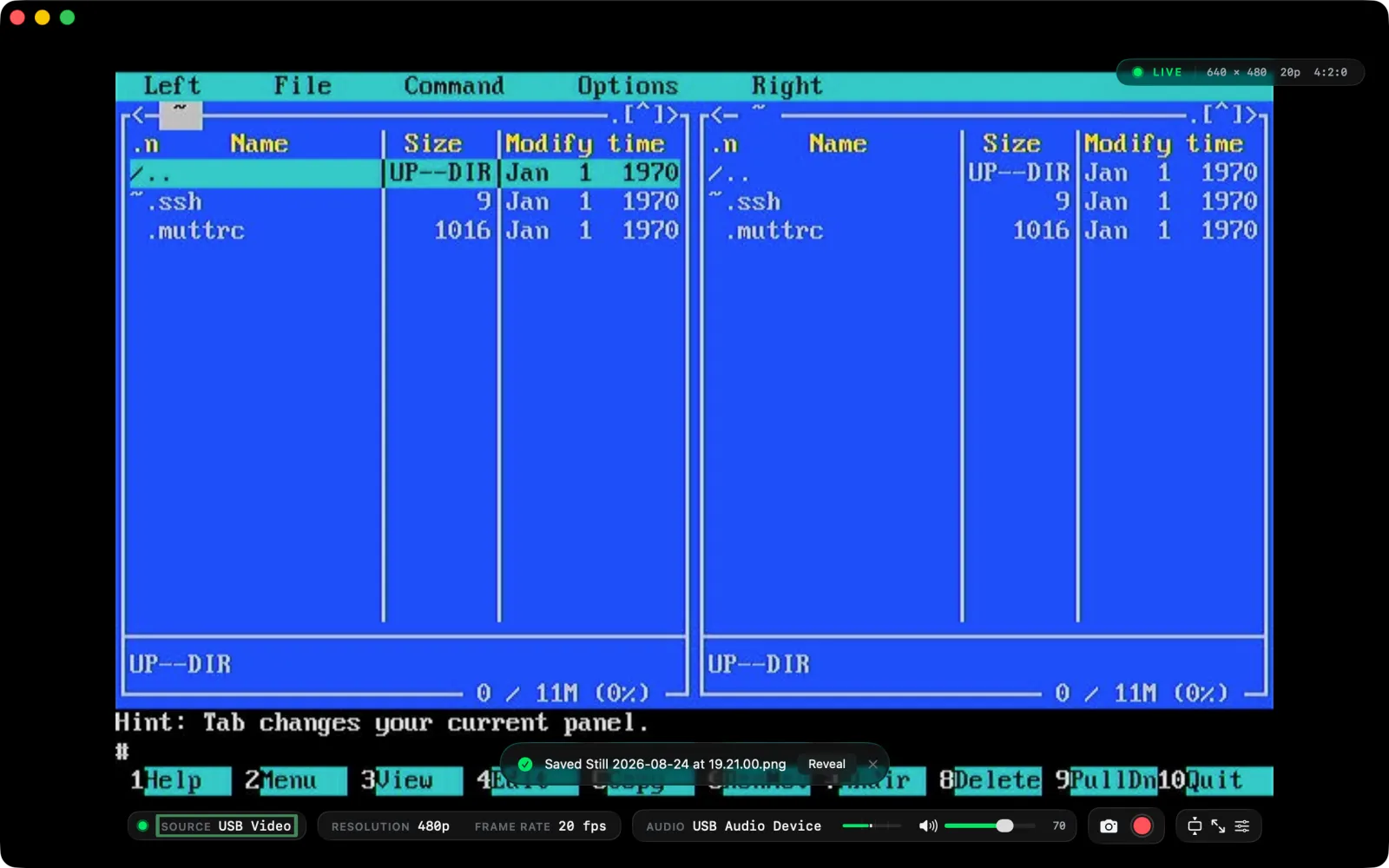
A capture card feeding a Midnight Commander session into the window. The status capsule reads LIVE, 640 by 480, 20p, 4:2:0; the control bar shows the source, resolution, frame rate, audio input and volume; and a notification reads Saved Still with the file name and a Reveal button.
Still ⌘S Saved to ~/Pictures/VideoMonk, named by date and time, with Reveal in Finder.

Keyboard

Everything on the bar has a key.

Clicking near a control never hides the chrome — there is a tolerance band around the bar, the status capsule and the source panel.
Save still⌘S
Start / stop recording⇧⌘R
Refresh sources⌘R
Show source details⌘I
Mute⌘M
Show / hide controls⌥⌘C

Where files land

  • ~/Pictures/VideoMonk Stills, as PNG or JPEG
  • ~/Movies/VideoMonk Recordings, video plus the selected audio input, as .mov

Requirements

macOS 26 or later.

VideoMonk is a native Swift app and uses the Liquid Glass interface introduced in macOS 26, so it will not run on older systems. On first launch macOS asks for camera and microphone access: the camera is required for a picture, the microphone only if you want to monitor audio.

Coming to the Mac App Store Support